Amex Platinum Review (2026): Is the $895 Fee Worth It? All 17 Credits, Analyzed
The complete guide to the Amex Platinum: every one of its 17 credits and perks with real-world usage tips, the lounge network explained, honest value math for the $895 fee, and who should actually get it.

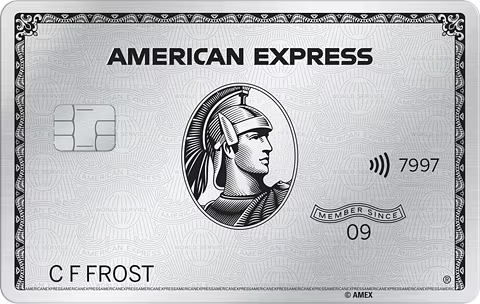
The card, honestly framed
The Platinum Card from American Express is the most famous premium card in the world, and in 2026 it costs $895 a year — the highest mainstream card fee in the U.S. Understanding whether it’s worth it starts with one mental shift: the Platinum is not really a credit card. It’s a travel-and-lifestyle membership that happens to process payments.
As a payment card it’s mediocre — 1x on almost everything. As a membership it bundles the best airport lounge network in the world, hotel elite status, and 17 separate credits worth $4,194 a year at face value in the MaxWorth database. The entire question of this review is how much of that face value your life can actually absorb — because Amex’s business model is betting that the answer is “less than $895.”
We’ll go through every credit with practical usage notes, explain the lounge system, do honest math for three kinds of users, and give a clear verdict.
Quick verdict
- Get it if you fly 6+ times a year through Centurion/Delta hub airports, can use the hotel credit on a stay you’d book anyway, and already pay for several of the things its credits cover (Uber, streaming, CLEAR, dining out)
- Skip it if you fly twice a year, hate managing coupons, or would be forcing purchases at lululemon and Saks just to “get your money back”
- Either way, don’t make it your only card — its 1x everyday earning needs a partner card
The welcome bonus: as high as 175,000 points
The current public offer runs as high as 175,000 Membership Rewards points after $8,000 in purchases in the first 6 months. Two things to know:
- “As high as” is literal. Amex shows different applicants different offers (125k and 150k versions circulate). Check your offer through card comparison tools or referrals before applying cold, and consider checking in incognito/different browsers — offers genuinely vary.
- Pop-up jail is real. Amex’s lifetime-language rules mean past bonuses or heavy recent card activity can trigger an eligibility pop-up during the application. The pop-up blocks only the bonus, not the approval — if you see it, abandon the application and preserve your eligibility for another day.
At MaxWorth’s ≈1.4¢ valuation of Membership Rewards, 175k points is worth ≈$2,450 — enough to cover the first two years of fees by itself, and far more if you transfer to airline partners well.
Earning: the weak spot, by design
| Category | Rate |
|---|---|
| Flights booked directly with airlines or via Amex Travel | 5x (up to $500k/calendar year) |
| Prepaid hotels via Amex Travel | 5x |
| Everything else | 1x |
5x on airfare is genuinely excellent — for someone spending $10k a year on flights, that’s ≈$700 in points value. But 1x on everything else is bad, and Amex isn’t embarrassed about it: this card was never designed to be your grocery card. The standard setup is Platinum for flights + lounges + credits, and a different card (a 2% flat card, or a dining/grocery earner) for daily spending.
What you earn are Membership Rewards points, one of the two most valuable transferable currencies. The floor is ≈0.6¢ (statement credit — never do this); the everyday value is ≈1.0–1.1¢ through the portal; the real value is 1.4¢+ via transfers to partners like ANA, Air Canada Aeroplan, British Airways Avios, Virgin Atlantic, Delta, Hilton and Marriott. If you’ll never transfer points, the Platinum’s rewards case weakens materially.
The lounge network: still the best in the game
This is the perk that sells the card, and nothing else on the market matches it. The Global Lounge Collection spans 1,550+ lounges and includes:
- Centurion Lounges — Amex’s own network and the crown jewel: real food, real bars, 25+ locations and growing. Crowding is the known complaint; Amex has been enforcing entry windows (within 3 hours of departure) to manage it. Guests cost extra unless you spend $75k/year on the card.
- Delta Sky Club — 10 visits per calendar year when flying Delta same-day (unlimited access requires that same $75k annual spend). For occasional Delta flyers, 10 visits is plenty; for weekly Delta flyers it’s a real cap to plan around.
- Priority Pass Select — 1,700+ lounges worldwide after (free) enrollment. Note Amex’s version excludes the restaurant credits some other cards’ Priority Pass includes.
- Escape Lounges, Plaza Premium, Lufthansa lounges (when flying Lufthansa Group) — the quiet depth of the network, especially internationally.
Realistic value: a traveler taking 12+ lounge-eligible trips a year, sometimes with a companion, plausibly gets $400–600 of genuine value here. That’s the anchor of the whole proposition.
All 17 credits and perks, one by one
Face values from the MaxWorth database, which tracks this card’s benefits line by line. “Enrollment” means you must activate the benefit in your Amex account first — set aside 15 minutes after approval and enroll in everything.
| Benefit | Face value/yr | Cycle | Enrollment |
|---|---|---|---|
| $600 Hotel Credit (FHR/THC) | $600 | $300 × 2 halves | Yes |
| Centurion Lounge Access | ≈$500 | — | No |
| $400 Resy Credit | $400 | $100/quarter | Yes |
| Delta Sky Club (10 visits) | ≈$390 | annual | No |
| $25 Monthly Digital Entertainment | $300 | monthly | Yes |
| $300 Equinox Credit | $300 | annual | Yes |
| $300 lululemon Credit | $300 | $75/quarter | Yes |
| CLEAR Plus Credit | $209 | annual | No |
| $200 Airline Fee Credit | $200 | calendar year | Yes |
| $15 Monthly Uber Cash | $200 | monthly ($35 Dec) | Yes |
| $200 Oura Ring Credit | $200 | annual | Yes |
| $12.95 Monthly Walmart+ | $155 | monthly | No |
| Global Entry / TSA PreCheck | $120 | every 4 years | No |
| $120 Uber One Membership | $120 | annual | Yes |
| Saks Fifth Avenue Credit | $100 | $50 × 2 halves | No |
| Hilton Honors Gold Status | ≈$50 | — | Yes |
| Marriott Bonvoy Gold Status | ≈$50 | — | Yes |
Now the honest per-credit analysis, grouped by how they behave:
The travel core (easy value if you travel at all)
- $600 Hotel Credit — $300 per half-year on prepaid Fine Hotels + Resorts or The Hotel Collection bookings through Amex Travel. FHR adds breakfast for two, $100 property credit, and upgrades where available — on a hotel you’d book anyway, this is the single most valuable credit on the card. The catches: THC needs a 2-night minimum, rates are prepaid, and the semi-annual split means you need two qualifying bookings a year to capture all $600. It’s also the credit with the most fine print — our $600 hotel credit guide covers the booking-date trick, third-night-free stacking, and the honest net-value math.
- $200 Airline Fee Credit — covers incidental fees (bags, seats, lounge day passes) on one airline you pre-select each calendar year. It does not cover tickets. Pick your main airline in January; forgetting to select is the #1 way this credit dies.
- CLEAR Plus ($209) — covers a full CLEAR membership. Combined with the Global Entry/TSA PreCheck credit ($120 every 4 years), security lines mostly stop existing for you.
- Uber: $200 Uber Cash + $120 Uber One — $15/month (+$35 in December) auto-loaded to your Uber account, plus a separate credit covering an auto-renewing Uber One membership. Monthly slices expire; if you Uber or UberEats even twice a month, this is effortless.
The lifestyle stack (great if it matches your life, noise if not)
- $400 Resy Credit — $100/quarter at U.S. Resy-affiliated restaurants, charged like any normal meal. In major cities where Resy is everywhere, this is nearly free money for people who eat out; elsewhere, check the Resy app for coverage before counting it.
- $300 Digital Entertainment — $25/month against Disney+, Hulu, ESPN+, NYT, Peacock, Paramount+, YouTube Premium/TV and more. If your household already streams, this is $300 of real money.
- $300 lululemon Credit — $75/quarter, in-store or online. Either you shop there (free money) or you don’t (a quarterly chore that mostly buys socks).
- $300 Equinox / $200 Oura Ring — the “wellness bundle.” Equinox members and Oura owners get face value; everyone else should ignore these rather than buy a $200 ring to save $200.
- $155 Walmart+ — covers the monthly membership (which also bundles Paramount+). Groceries-delivery households: easy yes.
- $100 Saks — $50 per half. Famous for expiring unused; set two calendar reminders and buy something you actually want.
The statuses (small on paper, occasionally huge)
- Hilton Gold + Marriott Gold — free breakfast at Hilton properties (Gold’s signature perk), bonus points, and upgrade eligibility at both chains, for zero nights of qualification. Face value is modest, but one good upgrade or a week of breakfasts beats it.
Also in the fine print: a set of travel protections (trip delay and cancellation coverage on eligible bookings, secondary rental car coverage, purchase protection and extended warranty on purchases, and cell phone protection when you pay your bill with the card). Never the headline, quietly useful.
The real math: three honest profiles
Face value $4,194 means nothing; here’s what absorption actually looks like:
| Profile | Credits realistically captured | Verdict at $895 |
|---|---|---|
| Frequent flyer in a hub city (12+ trips, eats out, streams, Ubers) | Hotel $600 + Resy $350 + entertainment $300 + Uber $260 + CLEAR $209 + airline $150 + Saks $50 ≈ $1,900+, plus lounges | Clearly worth it |
| Moderate traveler (4–6 trips, some subscriptions) | Hotel $300 + entertainment $300 + Uber $180 + CLEAR $209 + GE $30 ≈ $1,000, plus some lounge value | Roughly break-even — decided by how much you value lounges |
| Aspirational holder (1–2 trips, keeps it for the metal) | Streaming $300 + scattered $200 ≈ $500 | Paying $400/year for a status symbol |
The pattern is blunt: this card pays people whose lives already look like its coupon book, and taxes everyone else. The single best exercise before applying (or before renewal) is to go down the 17-line table and mark only the credits you’d use without changing behavior. If that number plus your honest lounge value doesn’t beat $895, believe your own math over the marketing.
What we don’t love
- 1x earning outside travel — requires a second card, full stop
- Coupon fatigue is the business model — monthly/quarterly slices, enrollment requirements and pre-selection exist precisely because breakage is profitable
- Additional Platinum cards cost extra — sharing the perks with family multiplies the fee (companion Gold cards are free but skip most benefits; check current pricing)
- Centurion crowding — the best lounges in the country are no longer a secret
- Pop-up jail — bonus eligibility is opaque and can sting churners
How it compares
- vs Chase Sapphire Reserve ($795) — CSR earns better on everyday travel/dining and its credits (The Edit hotel credit) are chunkier and simpler; Amex wins decisively on lounges. Read our CSR review for the full breakdown.
- vs Robinhood Platinum ($695) — the new challenger undercuts on fee with 10% hotel rewards, but has no lounge network of its own and an invite-only queue.
- vs Amex Gold — if most of your spending is groceries and dining rather than flights, Gold’s 4x categories out-earn the Platinum for $570 less. The classic power move is holding both.
Our take
The Platinum is the best travel-perks membership ever attached to a credit card, wrapped in the most aggressive coupon book in the industry. Both things are true. If you fly often, sit in lounges, book one nice hotel stay a year and already pay for the things its credits refund, it returns well over $895 with no behavior change — and the metal card is just a bonus. If you don’t, no spreadsheet of face values will make $895 a good deal, and the Sapphire Reserve or a simple 2% card will serve you better. Decide with the 17-line table, not the airport-ad version of your life.
Offer amounts, credits and terms change frequently — verify on the full card page and Amex’s site before applying. This is general information, not financial advice.
Frequently Asked Questions
Is the Amex Platinum worth $895 a year?
Only if your life already overlaps with its credits. Frequent flyers who use lounges, book one Fine Hotels stay a year and already pay for Uber and streaming can clear $895 without changing behavior. If you'd have to force spending to use the credits, it's not worth it.
What credit score do I need for the Amex Platinum?
Typically 700+, and Amex generally wants to see an established file. It's not a first card — build a year or two of history before applying.
Does the Platinum earn well on everyday spending?
No — that's its biggest weakness. Outside of 5x on flights and prepaid Amex Travel hotels, everything earns 1x. Most holders pair it with a card that earns well on daily spending and use the Platinum for flights, credits and lounges.
What is Amex 'pop-up jail'?
When you apply, Amex may show a pop-up saying you're not eligible for the welcome offer (usually because of past bonuses or heavy churning). You can still be approved for the card — but without the points. If you see the pop-up, close the application and try again another time.
Can I have the Platinum and still use another bank's cards?
Of course — and you should. The standard setup treats the Platinum as a travel-benefits membership, with a separate high-earning card for groceries, dining and everything else.